In-Memory Computing
CIM architectures that move computation into the memory array, collapsing the data-movement bottleneck that dominates modern AI accelerators.
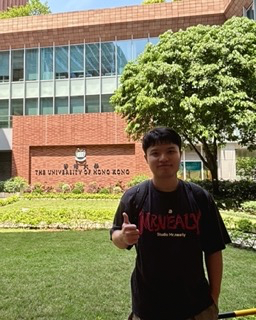
Ph.D. Student @ The University of Hong Kong
Bridging advanced AI algorithms with practical high-performance hardware.
I am a Ph.D. student in Electrical and Electronic Engineering at The University of Hong Kong, where I work on making large AI models cheap enough to run everywhere. Before that I was a research scientist intern at PIMIC Inc., working on on-device speech dialogue, 4-bit inference and preliminary ASIC design.
My research sits at the intersection of algorithms and circuits: in-memory computing architectures, ultra-low-bit quantization for large language models, and hardware–software co-optimization for ASIC design. I am passionate about building efficient AI systems that deliver real-world impact on edge devices.
Mission: make large AI models cheap enough to run anywhere.
CIM architectures that move computation into the memory array, collapsing the data-movement bottleneck that dominates modern AI accelerators.
Post-training quantization down to 2–4 bits, including trit-plane representations that push LLM inference into genuinely low-precision territory.
Joint algorithm-and-ASIC design — from kernel fusion and token-aware dataflow to tape-out ready circuits that exploit memristor devices.
Sep 2024 – Aug 2028
Ph.D. in Electrical and Electronic Engineering
Advisors: Prof. Ngai Wong, Prof. Can Li
Jul 2019 – Nov 2021
M.Sc. in Electrical and Electronic Engineering
Advisor: Prof. Wen Lei
Sep 2016 – Jun 2020
B.Eng. in Automation
Advisor: Prof. Xiaofang Hu
Fall 2025
The University of Hong Kong, Faculty of Engineering
Aug 2025 – Oct 2025
Institute of Microelectronics, Southern University of Science and Technology
Jun 2022 – Jan 2024
School of Artificial Intelligence, Southwest University
Sep 2024 – Aug 2025
PIMIC Inc. (USA), Hong Kong Science and Technology Park